|  The Anesthesia Brief · Issue #14 If you're thinking it, we're talking about it. By Marc Smith, DNP, CRNA & Shantall Ruiz Cummins, DNP, CRNA Here is what is on our minds this week. Let's get into it. | California CRNAs take the medical staff rules to courtIf your hospital's medical staff has no seat for you, you have no say in the rules that govern your own practice. That is what California CRNAs are taking to court.
On October 1, the California Association of Nurse Anesthesiology (CANA) sued the California Department of Public Health and the Office of Administrative Law in San Francisco Superior Court. CANA says CDPH's regulations keep CRNAs off hospital medical staffs, and that those rules go further than state law allows. CANA points to Business & Professions Code sections 2282(b) and 2283(a), which let medical staffs include licensed practitioners competent in their fields. It asks the court to invalidate four sections of Title 22.
The human cost is in the complaint. CANA says CDPH cited rural and critical access hospitals in 2024 for credentialing CRNAs as independent practitioners. It says at least two of them pulled every CRNA off their medical staffs without notice, and CANA's news page ties that to nearly 1,000 canceled surgeries in underserved communities. The complaint itself says thousands. CANA says patients lost access to care.
The fight goes back decades. CANA says it first petitioned over this in 1988 and its latest petition, filed in December 2023, was denied by CDPH in September 2025. CDPH has a different read. Its September 2025 denial letter says it lacks authority to go further than the Legislature has, because AB 890 gave medical staff eligibility to certain certified nurse practitioners, not to every independent practitioner. CDPH's own 2024 guidance already says a California CRNA does not need supervision from an anesthesiologist or the operating practitioner, so this is a fight over a seat at the table, not over supervision. The court will decide who is reading the law correctly. A state law is the ceiling, and the facility decides whether you practice to it. Watch this lawsuit, whatever state you work in. Why it matters: Medical staff membership decides whether CRNAs have a voice in the rules, privileges and coverage at their own hospital. Our take is at the bottom of this issue ↓ | One question to add at your next pre-opWhy it matters: Inhaled cannabis may change how much propofol a patient needs, and the only way to find out is to ask the question the right way. At your next pre-op, add one question: do you use cannabis, and how? Patients’ answers vary, so ask it the same way every time.
This is trending because of a new study at ANESTHESIOLOGY 2026. At one center, patients who smoked or vaped cannabis averaged 192.8 mg of initial propofol for upper endoscopy, versus 151.4 mg for non-users (38 patients versus 217). Edibles and colonoscopy did not show the gap, and the numbers are small. It is also not the first word on the topic. A 2025 meta-analysis pointed to more propofol in cannabis users, and a small AANA Journal study found no difference.
We are not telling anyone how to dose. We are curious what you see. Does a cannabis history change how you plan sedation, or does it wash out once the patient is on the table?
| 💬 Have you ever…?Had a patient say “just occasionally” and then need way more propofol than you planned?Tell us what you saw. DM @clockoutandconnectpodcast, we would love to know more. |
| 45% cut in anesthetic emissions at one health system Why it matters: It shows a unit can shrink its footprint with feedback and small habit changes, with no reported increase in the safety outcomes measured. That is how much one academic health system cut its per-episode anesthetic emissions, from 57.6 to 31.6 kgCO2e across 145,917 anesthetic episodes. They used more sevoflurane and IV anesthesia, turned down fresh gas flow, and sent each anesthesiologist an individual emissions report. Desflurane fell from 23.8% to 9.81% of cases, and the study reported no increase in PACU stay, hospital stay, reintubation, awareness or PONV. Nobody loves a report card, but this one worked. Would your numbers hold up? |
| The night before surgery may matter more than we thinkWe spend so much energy on the hour of surgery itself. What if the night before is the part we have been ignoring?
A review presented at ANESTHESIOLOGY 2026 looked at 16 studies from 2000 to 2025 (more than 1,100 patients) and linked melatonin and zolpidem (Ambien) before surgery to better sleep and less pain and opioid use afterward. Earlier reviews were more guarded and called the evidence weak or low quality, and zolpidem carries label warnings for complex sleep behaviors, falls and delirium.
So this is a conversation, not a protocol. What do you actually do for a patient who has not slept in days before a big case, and what would you want to see before changing it?
| 💬 Be honestWhat is your own night-before ritual when you know a big case is coming? Melatonin, a podcast, staring at the ceiling?Send it in at @clockoutandconnectpodcast. No judgment, we have all been the ceiling starer. |
| Cuff pressure gets a real measurementWhy it matters: Cuff pressure is a step you take on every intubation, and a 2016 meta-analysis plus a new AANA Journal congress poster make the case for measuring it instead of guessing. A 2016 systematic review and meta-analysis in Anaesthesia and Intensive Care found preliminary evidence that setting cuff pressure with a manometer, instead of by feel, meant lower odds of cough at two hours, hoarseness at 24 hours and sore throat. The newest push is a congress poster abstract in the AANA Journal’s October issue, which describes an educational infographic on manometer use that a panel of 12 experts called a credible teaching tool. It has not been tested in clinical practice yet. Most of us have inflated a cuff by feel, with the confidence of someone seasoning soup. Does your cart have a way to measure it, or is it all thumb and vibes?
| 🎨 The Comic Strip: 20 Minutes, Tops | 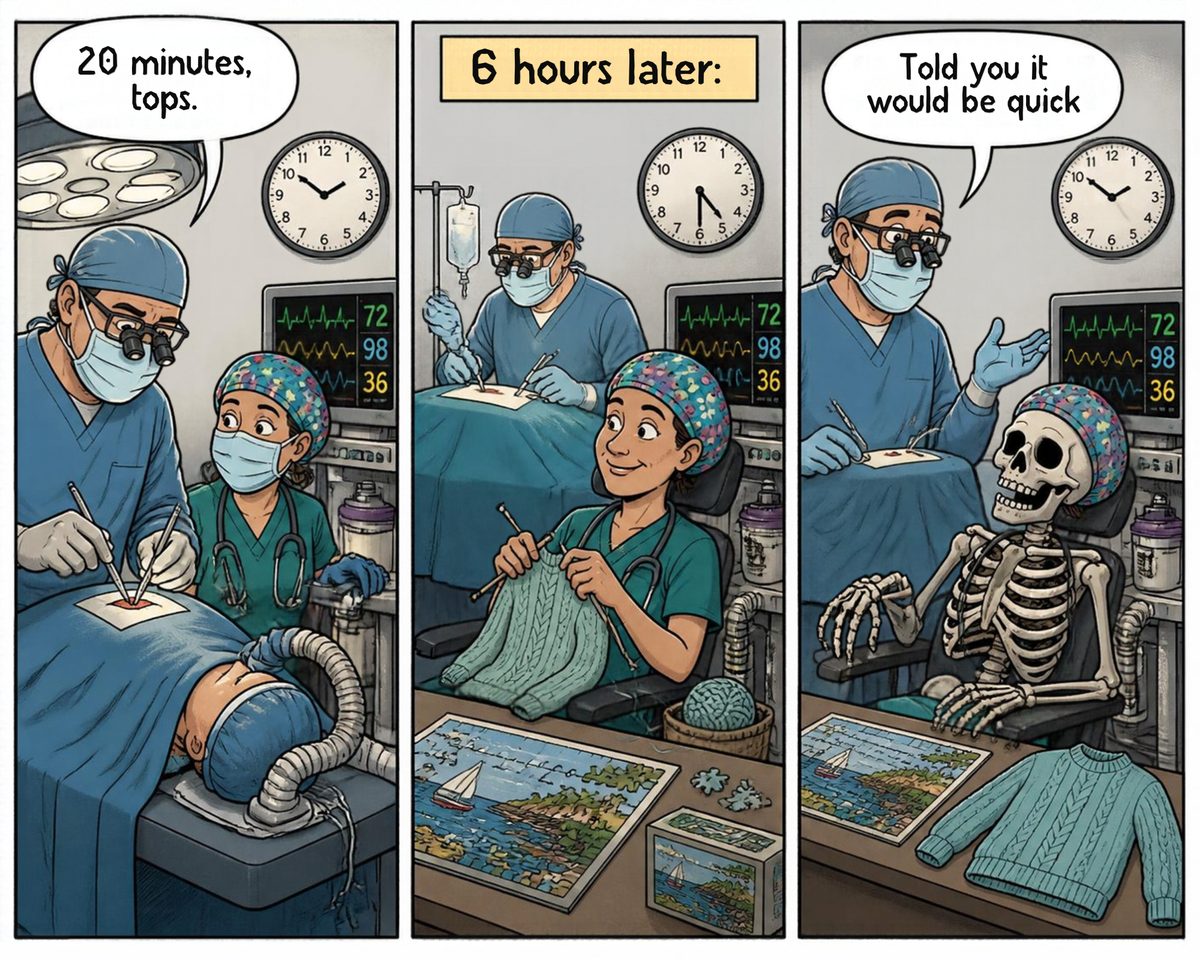 |
🧔 Dad Joke of the Week (we are not sorry)Why did the endotracheal tube cuff go to therapy?
Too much pressure. 🥁Groans are welcome. Send us your worst one at @clockoutandconnectpodcast. |
→ Tech watch | On the seat at the table, and the questions worth askingThis story is about who gets a voice. A seat on the medical staff is where privileges, protocols and call coverage get decided. CRNAs already deliver safe anesthesia care in these hospitals, and being shut out of that table is a different problem from professional ability.
Here is what we keep coming back to, you can be fully licensed, fully trained, and still not be in the room where the rules get written. Does your hospital’s medical staff have a seat for you? Do you even know? Pull up your bylaws this week. It is the least fun reading assignment of the year, and it is homework worth doing.
We will be watching how the court reads those two statutes.
| 📣 Your turnWhat is the one question you wish someone had asked you before your last tough case?DM @clockoutandconnectpodcast. Your experience is the part of this Brief we cannot write for you, and we would love to hear it. |
| Marc & Shantall All episodes · Blog · Rate Calculator | Conversation starters, not clinical advice. Spot something inaccurate? Email [email protected] and we will fix it. You're receiving this because you subscribed to The Anesthesia Brief. | |
|


