|  The Anesthesia Brief · Issue #15 If you're thinking it, we're talking about it. By Marc Smith, DNP, CRNA & Shantall Ruiz Cummins, DNP, CRNA Here is what is on our minds this week. Let's get into it. | At our first live Break Room Q&A on Oct. 28, someone asked why CRNAs charge to mentor. Somebody else in the chat said they'd seen $12K. We don't get that either.
Mentorship is giving back. It's how we build up nursing, and it's never going to be something we charge for. We support the CRNA-led companies that built training programs and prep courses, because that's real work. Charging someone to be mentored is a different thing, and it's just not us. Someday we may build things worth paying for. Mentorship won't be one of them.
Marc has always mentored for free. And the day before the Q&A, Shantall worked a case with a senior SRNA who turned out to be someone she'd answered on Instagram back in 2021. So reach out. Plenty of CRNAs will help you for free.
Missed it or ran out of time? The replay is below, and we're answering leftover questions on our Instagram Stories. → Watch the Oct. 28 replay on YouTube | CRNA students put work-life balance ahead of payU.S. Anesthesia Partners (USAP) surveyed SRNAs at its fourth annual Future Leaders in Anesthesia conference in Austin, Sept. 27 to 28. On a first job, work-life balance led at 38 percent, double mentorship and onboarding support (19). Compensation drew 9 percent, tied with location. Looking at year one, 59 percent said building confidence was their biggest challenge, and 53 percent said mentorship from experienced CRNAs is the support that will matter most. Five years out, the top answers were practicing with a lot of autonomy (31 percent) and educating or mentoring future CRNAs (25).
Asked which subspecialty interests them most, obstetrics came first at 28 percent and trauma second at 25 percent, ahead of pediatrics (16), cardiac (16), regional (13) and neurosurgery (3).
Read it with the sample in mind. The 121 SRNAs at the conference were picked as future leaders by their program faculty and attended as guests of USAP, which employs CRNAs and published the results as a press release. USAP didn't say how many answered. Every chart moves in steps of about 3 percent, which points to roughly 32 responses, so 28 percent is likely around nine students.
- If you're an RN: these are the people a few years ahead of you, and their top first-year worry was confidence, not debt (9 percent).
- If you're an SRNA: 53 percent said mentorship will matter most. When you interview, ask exactly how a new grad gets mentored, by whom, and for how long.
- If you're a CRNA: a quarter of these students want to be educating or mentoring future CRNAs within five years. If you precept, you're who they're watching.
Why it matters: It's a look at what a faculty-picked group of SRNAs want from their first jobs: work-life balance first, mentorship from experienced CRNAs, and OB and trauma. Our take is at the bottom of this issue ↓ | Pop Quiz: name the MH triggersMalignant hyperthermia is rare, but you have to know the triggers. Which agents does the FDA label for dantrolene (Ryanodex) name as MH-triggering? A. Propofol and rocuronium B. Volatile anesthetic gases and succinylcholine C. Midazolam and fentanyl Lock in your answer. It is at the bottom of this issue ↓ |
| Find your people earlyShantall almost failed her first semester, and she said it on mic in Episode 8. What turned it around was people:
“My classmates helped me, especially some of the classmates that were in the top percentage. They took their time to actually help me get through that part. But once I locked in and found my people in the group, we had our study group, we got together every week, went over everything, I did fine.”
So ask early, before the grade forces it, and get a weekly study group on the calendar. → Listen to Episode 8 | Two anesthesia machine recalls to knowTwo FDA Class II recalls on anesthesia machines, both posted this fall, worth a minute at your next machine check.
GE Datex-Ohmeda Aisys, Aisys CS2 and Aisys CS2 with Et Control: the gas mixer can switch to Alternate O2 control, which means 100% O2, alarms, and interrupted agent delivery that needs a clinician to step in, with a risk of decreased anesthetic effect. GE's instructions: do the preop checkout per the user reference manual, and if the Agent quick key is blank, supplement with or transition to intravenous anesthetics as needed.
Maquet Flow-i C20, C30 and C40, plus Flow-c and Flow-e, on software 4.8, 4.10 and 4.11: agent was not delivered when the vaporizer was activated, which may lead to intraoperative awareness. The precaution is to confirm agent delivery. Know which machine you're on. | 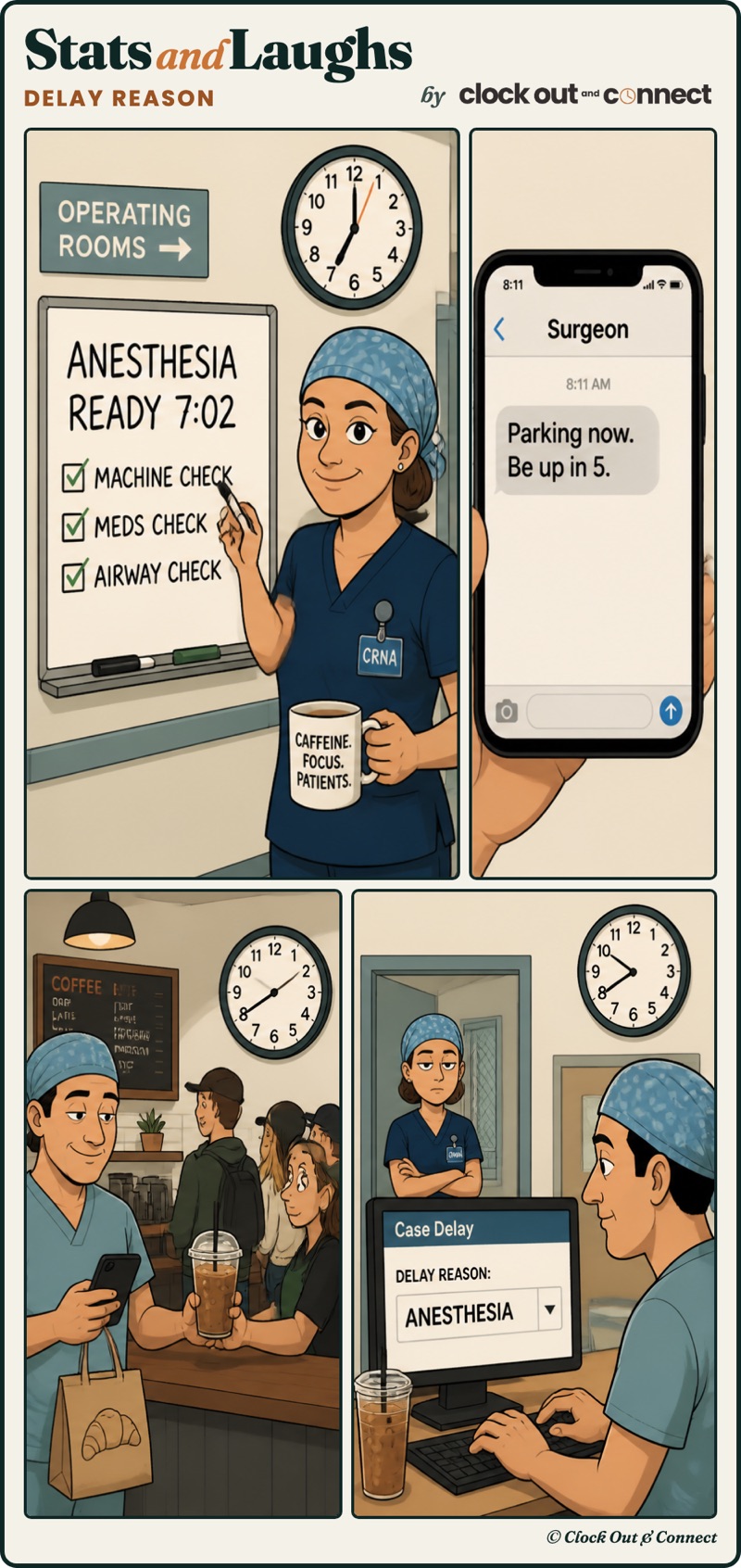 | 🧔 Dad Joke of the Week (we are not sorry)What did the CRNA say about the expiring lidocaine?
“Its days are numb-ered.” 🥁 |
| 18,901 responses, headed to CMSWhy it matters: 18,901 responses is what AANA carries into its CMS meeting on the federal supervision requirement. At AANA's Oct. 14 virtual Town Hall, President Tracy Young, MSNA, MBA, CRNA, said the grassroots campaign urging senators to support removing the federal CRNA supervision requirement drew a record 18,901 responses, ahead of an upcoming meeting with CMS.
The new strategic plan, built on input from nearly 5,800 members, rests on three pillars: Develop and Own the Evidence, Define Standards of Excellence, and Dominate Policy. On anesthesiologist assistants, Young said AANA has no formal national policy supporting CRNA supervision of AAs, and federal Medicare rules currently require anesthesiologist supervision of AAs. AANA's RN membership category topped 3,000 as of August, and Town Halls are going quarterly. The next one is Dec. 8. (AANA News, Oct. 19) → Full scope tracker + your state | They're asking for mentors. That means us.Fifty-nine percent. That's how many of these students said building confidence is the hardest part of year one. Student debt got 9 percent. So maybe the money isn't what keeps them up at night.
And what they said would help most was mentorship from experienced CRNAs, at 53 percent. Listen, that one's on us. If a new grad starts at your place this year, take the extra five minutes and let them ask the question they think is dumb without it costing them anything.
Keep the sample in mind, though. It's a small group their faculty hand-picked, and the survey came from a company that hires CRNAs, so treat it as a signal, not the whole class. | B. Volatile anesthetic gases and succinylcholine The Ryanodex label tells clinicians to discontinue MH-triggering anesthetic agents, and names them: volatile anesthetic gases and succinylcholine. → FDA label, Ryanodex (dantrolene sodium), NDA 205579 | Hit reply and tell us what you want us to dig into next week. | Marc & Shantall All episodes · Blog · Rate Calculator | Conversation starters, not clinical advice. Spot something inaccurate? Email [email protected] and we will fix it. You're receiving this because you subscribed to The Anesthesia Brief. | |
|


